
Mansur ibn Elyas Shirazi
Elyasi family
Shiraz is a city in the south of Iran, has been one of the centers of science and research in medical sciences from the 8th to the 19th centuries. It has a reputation for being the origin and home of famous doctors and academics, schools, libraries and hospitals. Those who studied in this city would often rise to become rulers or prominent in the court of rulers in India, Transoxania and Ottoman. One of the Shirazian families that have been outstanding in medical science, is the Elyasi family. This family lived in Persia from the Atabakan Seligori period (اتابکان سلجوقی) from the thirteenth to the Qajar period (قاجار) in the nineteenth century. One of the largest physicians of this family is Mansur ibn Elias Shirazi.
Mansur ibn Elyas Shirazi (منصور بن الیاس شیرازی)
Mansur Mansur ibn Elyas Shirazi (1380-1422 AD) is a well-known Iranian physician, surgeon and pharmacologist who was born in Shiraz. Most of his reputation was in the knowledge of anatomy, pharmacology and medicine. Ibn Elias, for the first time in the Islamic world and civilization, has traced accurately anatomical pictures, and also brought together archeological discussions of the womb and fetus in the field of women’s descriptions.
Books
He wrote a book on medicine entitled Shah Shoja Mozaffari (شاه شجاع مظفری), son of Zine al-Abedin (زین العابدین), “Kifāyah-i Mujāhidīyah” (کفایه المجاهدیه) or Kifāyah-i Mansuri(کفایه المنصوری). The book consists of two parts: the first deals with the theoretical and practical aspects of medicine and the second deals with the subject of citrus spices.
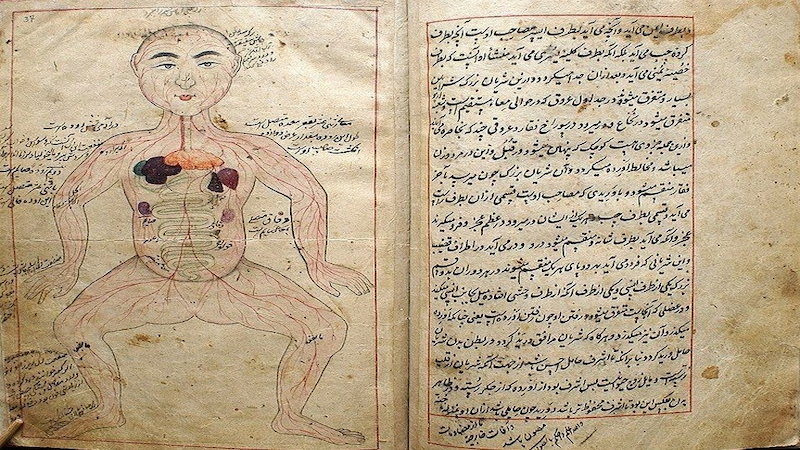
From this physician, a book titled Tashrihi Mansuri (تشریح منصوری)(Persian language) has survived in Persia, which was presented to the governor of the Persian Gurkani, Pir Muhammad ibn Jahangir (1374 1407), with the names of the Enlightenment. Tashṛiḥ- belTasvir, Tashṛiḥ-i badan-i insān, Sharih al-Badan and Resaleh fi elm Tashriḥ (تشریح بالتصویر، تشریح بدن انسان، شرح الابدان، رساله فی علم تشریح) are also known and have one introduction and fie chapters In the description of bones and nerves, muscles and vessels.
A considerable portion of the book has been dedicated to the central and peripheral nervous system so that he could be considered as one of the pioneers of neuroanatomy. The book of Mansur is believed to be the first anatomical illustrated manuscript containing two-dimensional pictures of the human body. This 14th-century treatise is composed in Persian and is organized into five articles on the skeleton, nerves, muscles, veins and arteries, each illustrated with a full page diagram and with a final chapter including an image of a pregnant woman delivering a breech baby. These chapters have a description part and related figures involving brief explanations. Mansur’s illustrations were often used in other Persian or Arabic medical manuscripts for at least two centuries in Persia.
References
- Golshani SA, Golshan E. Mansoor Ibn Elyas Shirazi: The Exact Retrospective of the Anatomy of Women in Iranian Medicine. MOJ Anat & Physiol. 2017;4(4):00146.
- Zarshenas MM, Zargaran A, Mehdizadeh A, Mohagheghzadeh A. Mansur ibn Ilyas (1380–1422 AD): A Persian anatomist and his book of anatomy, Tashrih-i Mansuri. Journal of medical biography. 2016 Feb;24(1):67-71.
- Daneshfard B, Sadr M, Abdolahinia A, Azari H, Naseri M, Iranzadasl M, Velayati A. Mansur ibn Ilyas Shirazi (1380–1422 AD), a pioneer of neuroanatomy. Neurological Sciences. 2021 Oct 31:1-4.
About the Author: Azam Khosravi


