What is Persian Medicine ?
What is the Mizaj ?
In modern medicine, it is well known that healthy individuals have different physical and mental characteristics and there is genetic variation within races and between them. This can also be deduced from the point that different paraclinical findings and anthropometric indices have a wide normal spectrum in the healthy individuals. Most of the traditional medical schools such as Traditional Chinese Medicine (TCM), Ayurveda and specially Persian (Unani) Medicine (PM) have based their diagnosis and treatment decisions on the discrimination of these differences.
Nowadays, conventional medicine is also going towards the personalized medicine and paying attention to individual differences in the pathogenesis, progression of diseases and response to therapeutics, for example, pharmacogenetics that tries to classify individuals according to their possible response to a medicine and other particular contexts such as metabonomics and nutrigenomics are new promising areas of the personalized medicine.
The school of Persian Medicine that originated from the ancient Persian civilization was established upon the basic concept of mizaj (Temperament). According to this, each person has a unique characteristic named mizaj which is recognized and classified by his or her morphological, physiological and psychological features.
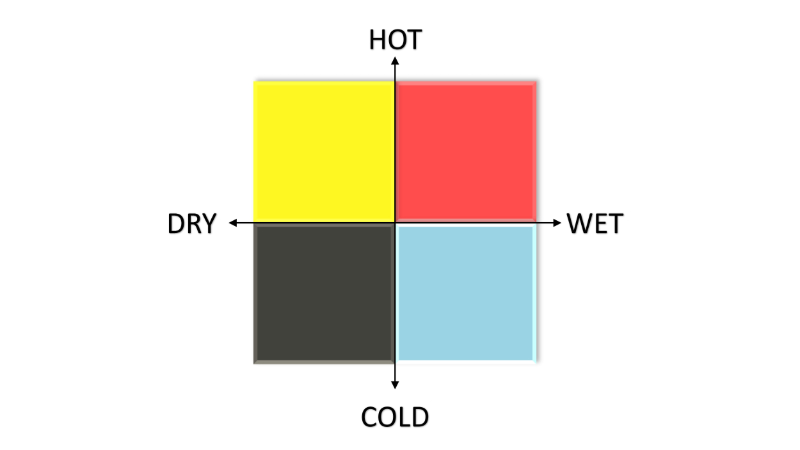
In PM a person is considered to be in a healthy state when his or her mizaj keeps its balance and most of the diseases occur when the mizaj becomes imbalanced. It is believed in PM that the number of mizaj equals the number of living individuals in the world. Since numerous number of mizaj may be imagined, the leading figures of PM have divided all kinds of mizaj into nine major groups for easy assessment. These nine groups may be imagined as the sectors of a two dimensional spectrum of different degrees of warmness and wetness. These sectors include one central equable region and eight circumferential non-equable regions which consists of four simple (Warm, Cold, Moist, Dry) and four combined mizajes (Warm and Moist, Warm and Dry, Cold and Moist, Cold and Dry).
In the context of this opinion each member of these groups is susceptible to certain diseases related to his or her mizaj and may need different treatments for the same disease and even different life style recommendations for the health care and disease prevention. In other words the mizaj acts as a guiding force for maintenance and preservation of individuals’ health, for example, an individual with cold and moist mizaj is recommended to have more physical activity than warm and dry. Individuals are sorted into these nine major groups of mizaj by the use of mizaj identification criteria.
Avicenna (Ibn Sina, 980-1037 A.D.) the famous Iranian scientist, defined these criteria and described the indices of each criterion in his medical book “The Canon of Medicine”. Most of these indices are qualitative and their discrimination capabilities have not been assessed.
About the Author: Meysam Masoudi